Do you want to stay updated on our news and promotions 😊 ?


%20LOW-1.jpg?1775574454)
%20LOW-1.jpg?1775574470)
%20LOW-1.jpg?1775574505)
%20LOW-1.jpg?1775575294)

-1.jpg?1775575326)
%20LOW-1.jpg?1775575371)
%20LOW-1.jpg?1775575451)
%20LOW-1.jpg?1775575470)
-1.jpg?1774258454)
%20LOW-1.jpg?1774258469)
Other references
Cod. Series TM
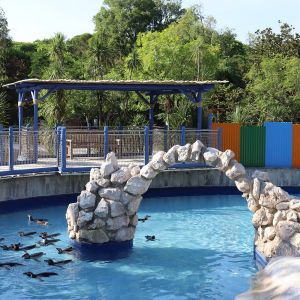
In addition to the main installations for specific habitats, AFRICA STYLE has carried out a series of theming interventions spread throughout the park's route, to combine visual coherence, usability and technical durability, without ever sacrificing the quality of the materials and design care. Refreshment areas and relaxation areas feature natural Makuti Palm umbrellas, particularly suitable for creating comfortable and dramatic shade in rest areas, thanks to their texture and visual rendering typical of tropical architecture. Where required by the context, such as the panoramic terrace overlooking the park's central pond, umbrellas in ShadySynth Tobacco have been added: a high-performance synthetic material that maintains the natural effect, increases durability over time and offers effective shade even in highly exposed environments. These areas thus become popular rest stops for families and groups without interrupting the park's aesthetics. The aviary entrances have been enhanced with customized facilities in ShadySynth Tobacco, creating reception points consistent with the wildlife theme and facilitating access to bird observation areas. Along the pedestrian paths, large umbrellas in natural Makuti Palm have been placed near the main rest areas, offering shade and comfort, transforming simple waiting points into natural settings that invite contemplation of the environment. Close to the Seychelles Tortoise area, AFRICA STYLE has created technical monoblocks completely clad in Eucalyptus poles, fully integrating the service function into the overall theming of the area. The turtle enclosure has been equipped with the smallest size of the African Fence, one of the best-sellers, designed to withstand not only the weather but also the typical stresses provoked by animals, ensuring safety and durability over time. Still using Eucalyptus panels, AFRICA STYLE created the Crowned Crane enclosure with dedicated lookout points, where rectangular holes of varying heights were integrated to allow non-invasive observation of the species. Finally, the African Fence was distributed along the park's main path, orienting visitors between the various themed areas and creating a coherent and robust visual thread, suitable even for the most challenging outdoor conditions. This fence not only directs visitation flows, but also defines clear boundaries between human space and animal habitat, without being invasive or unnatural.
%20LOW.jpg?1774258469)
%20LOW.jpg?1774258469)
%20LOW.jpg?1774258469)
%20LOW.jpg?1774258469)
%20LOW.jpg?1774258469)
%20LOW.jpg?1774258469)
%20LOW.jpg?1774258469)
%20LOW.jpg?1774258469)
%20LOW.jpg?1774258469)
%20LOW.jpg?1774258469)
%20LOW.jpg?1774258469)
%20LOW.jpg?1774258469)
%20LOW.jpg?1774258469)
%20LOW.jpg?1774258469)
%20LOW.jpg?1774258469)
%20LOW.jpg?1774258469)
%20LOW.jpg?1774258469)
%20LOW.jpg?1774258469)